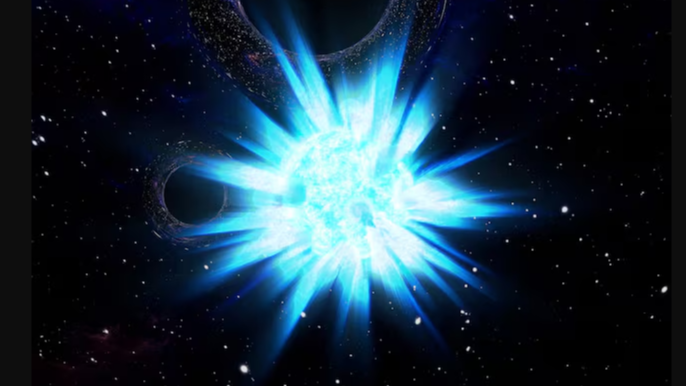
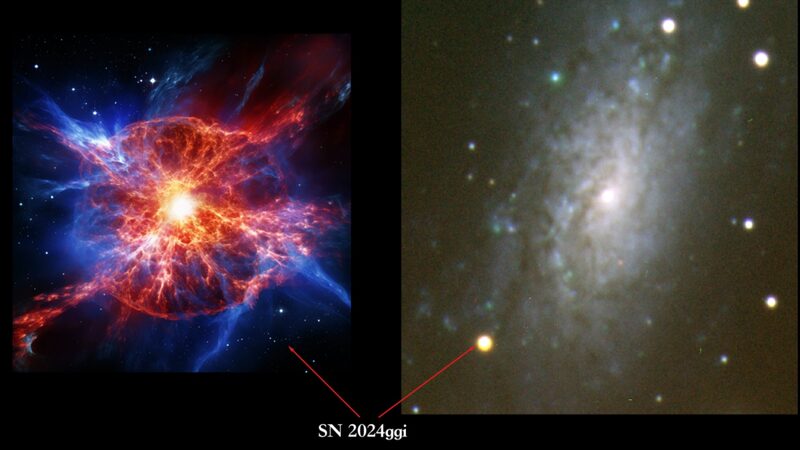
Hold onto your telescopes, space fans! 🔭 Researchers just found clues about pair-instability supernovas – cosmic explosions so violent they vaporize entire stars without leaving black holes or neutron stars behind. This discovery, published this week in Nature, could rewrite how we understand stellar life cycles.
Imagine a star 140-260 times heavier than our sun 🌞 burning out faster than a TikTok trend ⏳. These mega-stars collapse in seconds, triggering explosions 10 billion times brighter than our solar system’s centerpiece. ‘It’s like the universe’s ultimate mic drop,’ said study lead Hui Tong from Monash University.
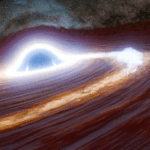
How’d scientists spot these elusive explosions? By studying black hole mergers detected through gravitational waves. They noticed a ‘forbidden range’ of missing black holes (44-116 solar masses) – suggesting massive stars in this range might’ve been completely obliterated instead of forming remnants.
‘These explosions are so powerful, they leave nothing but stardust and questions,’ added co-author Maya Fishbach. While no direct observations exist yet, this research gives astrophysicists new tools to hunt for these cosmic fireworks 🎆 in future sky surveys.
Why care? Understanding these supernovas helps decode how heavy elements spread through galaxies – the same stuff that makes up your phone, your coffee mug, and you. 💫