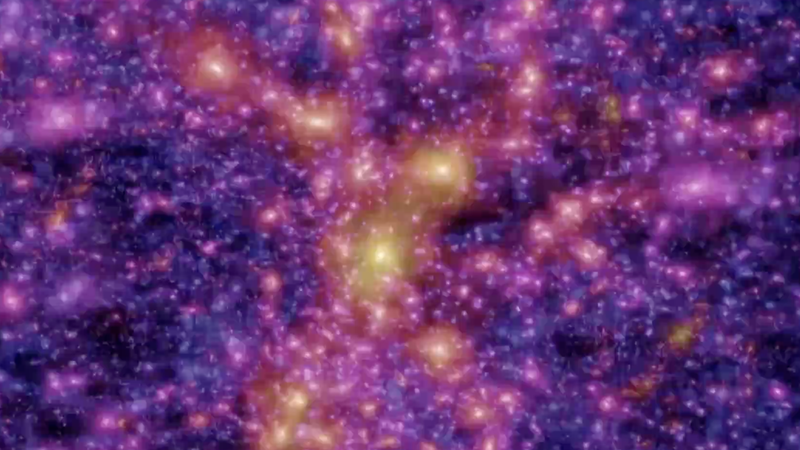
Scientists Have Recreated the Cosmos in a Supercomputer 🤯
Imagine being able to rewind the history of the universe from just after the Big Bang, watching galaxies form and cosmic webs stretch across billions of light-years. That's no longer just sci-fi fantasy. A Chinese-led international team of scientists has just dropped the largest-ever cosmological simulation, and it's a game-changer for astronomy.
The project, named 'HyperMillennium', is like the ultimate cosmic sandbox. It covers a mind-boggling virtual cube measuring 12 billion light-years on each side and uses a staggering 4.2 trillion virtual particles to model the mysterious dark matter that holds the cosmos together. Think of it as the most detailed and expansive video game ever made—but one that might unlock the universe's deepest secrets.
💡 How Do You Build a Virtual Universe?
The team used a technique called N-body simulation. In simple terms, they started with the raw ingredients just after the Big Bang and then let gravity do its thing, step by step, over 10 billion simulated years. By adding complex physics models on top, they can now generate detailed catalogs of virtual galaxies, complete with their brightness and positions.
"The simulation was completed with high force resolution and time accuracy," said Wang Qiao, a researcher at the National Astronomical Observatories of the Chinese Academy of Sciences. "It allows scientists to study extremely rare, massive cosmic structures in fine detail while maintaining strong statistical power."
🚀 A Computational Marvel
This wasn't done on a regular laptop. The team developed their own software, PhotoNs, specifically designed for powerful Chinese supercomputers. After over a decade of fine-tuning, they harnessed the power of more than 10,000 accelerator cards. The total effort consumed over 100 million CPU core-hours—a number that's hard to even visualize—and generated a whopping 13 petabytes of data. That's like streaming over 3 million hours of HD video!
🌌 Why Does This Matter?
This virtual cosmos is more than just a cool tech demo. It's a crucial tool for tackling two of the biggest mysteries in physics: dark matter and dark energy. It also provides essential theoretical support for next-generation astronomy missions, like the upcoming China Space Station Telescope (CSST) and the European Space Agency's Euclid spacecraft.
International experts are blown away. Mike Boylan-Kolchin, a professor at the University of Texas at Austin, called it a "computational marvel" that will help unlock secrets of the early universe. Volker Springel from Germany's Max Planck Institute for Astrophysics said it "redefines the limits of numerical cosmology."
✅ Testing It Against Reality
In a recent paper, the team proved their simulation's power by comparing its results with real observations of Abell 2744—a famous, chaotic galaxy cluster 4 billion light-years away. The virtual model matched reality down to the pixel level, confirming that our standard model of cosmology holds up even in the most extreme cosmic environments.
The best part? The first batch of this groundbreaking simulation data is already being shared with scientists worldwide through the National Astronomical Data Center, opening up new frontiers for discovery from classrooms to research labs everywhere. The cosmic playground is officially open! 🌠
Reference(s):
cgtn.com