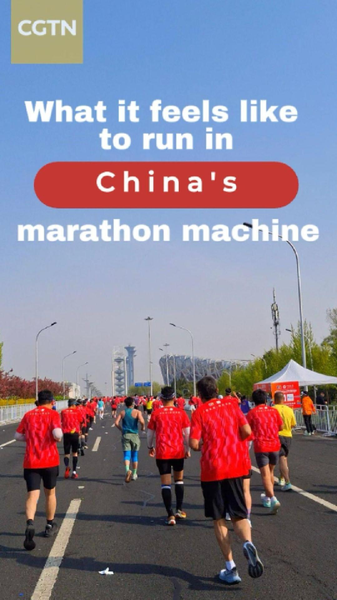
🏁 Beijing, 2026 — The scale hits you first. But the movement starts long before the starting gun. On an April morning in 2026, subway trains bound for Tiananmen Square are packed, carriages full of runners in their race gear, moving in unison even before the race officially begins. By the time they spill into the heart of the capital, they're a single current, a human river flowing into one of the world's most iconic public squares.
The road is dense with motion well before the race starts—a sea of athletes adjusting smartwatches, stretching, and inching forward in a slow, collective shuffle. The air buzzes with a steady chorus of "jiayou!" (加油), a uniquely Chinese cheer that translates to "keep going" or "go for it." It rises from both fellow runners and spectators, turning anxious waiting into active, kinetic energy. A simple exchange of nervous smiles and encouragement with the stranger next to you breaks the tension. In an instant, the overwhelming crowd becomes a shared community.
For a first-timer, the 21 kilometers ahead can feel abstract, almost unreal. What's immediate is the sensation of being absorbed into something much larger: a perfectly orchestrated machine of bodies, timing mats, and controlled momentum that moves whether you're ready or not. In a city like Beijing, where demand for major marathons now far exceeds the available spots, just making it to this starting line is an achievement. Standing there, surrounded by thousands, pinned against a route that cuts through the capital's history, you realize the race has already begun.
This is modern China's running culture in full stride—a massive, communal, and incredibly well-organized spectacle. It's less about the individual finish time and more about the collective experience, the feeling of being a single part of a vast, moving whole. For global runners and culture enthusiasts, it's an unforgettable way to connect with the pulse of a nation on the move. 👟🇨🇳
Reference(s):
cgtn.com