Ever feel like the world's cultures are worlds apart? 🌏 A closer look at the proverbs we live by might just reveal we're all speaking the same language of life.
Language is soft power in its most organic form. Every culture has its idioms—those compact, metaphor-rich phrases that pack a whole philosophy into a single sentence. In Chinese, this takes a particularly concentrated form: the chengyu (成语). These are four-character expressions drawn from classical texts and historical episodes, many of them over two millennia old. They're like cultural fossils, preserving ancient wisdom.
But the real magic happens when you hold them up against the proverbs of other cultures—from Europe and the Middle East to Africa and the Slavic world. These sayings developed independently, shaped by different landscapes, political systems, and intellectual traditions.
Yet, they often say the exact same things. 🤯
This raises a fascinating question, far beyond linguistics: If we've been whispering the same truths to ourselves for centuries, why do we spend so much energy insisting we're so different?
The Same Lessons, In Different Languages
Let's take a journey through some universal truths, as told by proverbs from around the globe.
1. On Uncertainty & Perspective
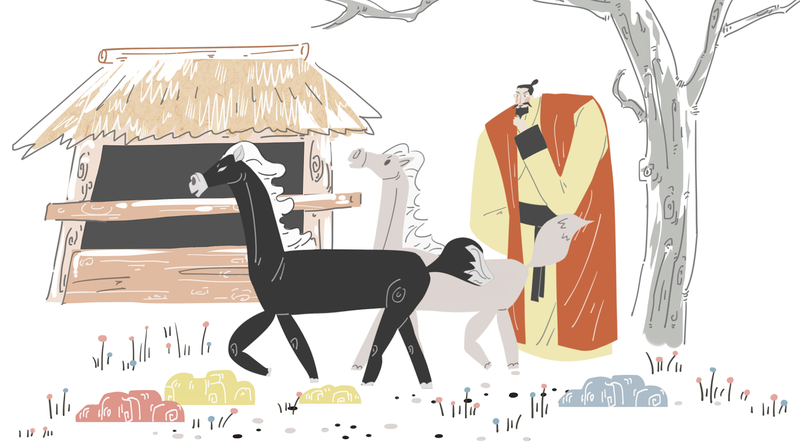
Chinese: 塞翁失马 (sài wēng shī mǎ) – The old man loses his horse. The story goes that an old man near the frontier loses his horse. Neighbors console him, but he calmly asks, "How do you know this isn't a blessing?" The horse returns with another fine horse. Then his son, riding the new horse, breaks his leg. When war comes, all able-bodied men are conscripted and perish. The son, with his broken leg, survives. The moral? Fortune and misfortune are intertwined; don't judge an event too quickly.
This mirrors the ancient Greek philosophy of "This too shall pass" and the English saying "Every cloud has a silver lining." It's a global reminder to embrace life's rollercoaster. 🎢
2. On Action & Procrastination
The English world warns, "Don't put all your eggs in one basket." Meanwhile, a Chinese chengyu advises: 狡兔三窟 (jiǎo tù sān kū) – A crafty rabbit has three burrows. It's the same call for preparedness and diversification, whether you're a medieval farmer or a savvy investor in 2026.
3. On Community & Cooperation
An African proverb states, "If you want to go fast, go alone. If you want to go far, go together." In China, the sentiment is captured in 众人拾柴火焰高 (zhòng rén shí chái huǒ yàn gāo) – When everyone gathers wood, the flame rises high. From the Savannah to the Silk Road, the message is clear: teamwork makes the dream work. 👫
Why Does This Matter in 2026?
In our hyper-connected yet often divided world, these linguistic echoes are more than just a cool fact. They're a gentle reminder of our shared human experience. Before we get lost in translation or amplify our differences, maybe we should listen to the wisdom our ancestors agreed on.
These proverbs were never "lost in translation" because their core truths are universal. They've been guiding lights for generations, across every continent. So next time you face a challenge or celebrate a success, remember—someone, somewhere, in a completely different time and place, probably had a proverb for that. And it likely meant the same thing.
Perhaps it's time we focus less on what makes our cultures unique and celebrate more what makes us universally human. After all, the greatest proverb of all might be one we're still writing together. ✨
Reference(s):
cgtn.com