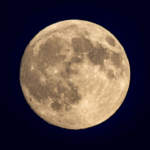
Did you look up at the sky last night? If you did, you witnessed a rare cosmic crossover! Yesterday, May 31, we were treated to a full moon that wasn't just any ordinary lunar event—it was a Blue Moon and the smallest full moon of 2026 all rolled into one. 🌌
First things first: let's clear up the biggest myth. Despite the name, a "Blue Moon" doesn't actually turn blue. No blue filters or neon lights here! 🙅♂️ In astronomy, a Blue Moon is simply the second full moon to occur within a single calendar month. Since the lunar cycle is about 29.53 days and most of our months are 30 or 31 days, every now and then we get a "bonus" moon. This May, we had full moons on both the 2nd and the 31st.
But wait, there's more! This particular moon was also the smallest of the year. According to Yang Jing from the Chinese Astronomical Society, this happens when a full moon coincides with the moon reaching its apogee—the farthest point from Earth in its elliptical orbit. 🚀
The timing was almost perfect: the full moon peaked at 4:45 p.m. on May 31, and the apogee hit at 12:33 p.m. today, June 1. Because these two events happened less than 20 hours apart, we got the smallest full moon of the year. It's a rare combo; the last time a Blue Moon was also the smallest of the year was back in 2020!
Can you actually tell the difference? 🤔
Honestly? With the naked eye, probably not. The difference in diameter between the largest and smallest full moons is about 14%, and the area differs by about 30%. However, if you're into photography, your camera lens will definitely catch the difference! 📸
If you missed this one, don't stress. There's another celestial event to look forward to: the largest full moon of 2026 is coming your way on December 24! 🎄🌕 Mark your calendars and get your cameras ready to compare the two. Until then, keep looking up! 🌍💬✨
Reference(s):
A rare celestial event: Blue moon meets the year's smallest full moon
cgtn.com