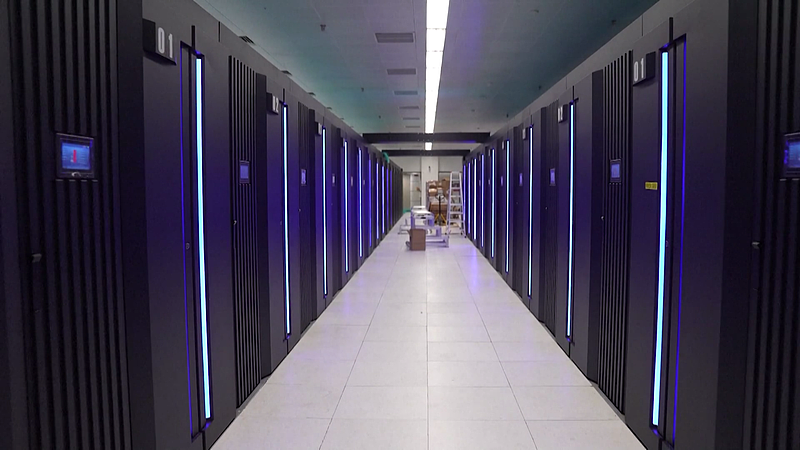
Imagine having 48 hours to build a miniature supercomputer from scratch while fighting a strict power budget. Sounds like a sci-fi movie? For over 300 teams of student geniuses, it was just another week at the 2026 ASC Student Supercomputer Challenge (ASC26)! 🌟
The grand finale wrapped up this Wednesday, May 20, at Wuxi University in the Chinese mainland's Jiangsu Province. After five days of intense coding, building, and optimizing, Peking University claimed the championship trophy, with Tsinghua University following closely as the runner-up. 🏆
Building Tech Under Pressure ⚡
This wasn't just about who had the fastest chips. The challenge was all about efficiency. Teams had to keep their power consumption under 5,000 watts—which is roughly the same as running ten household air conditioners at once. ❄️
Jack Dongarra, a Turing Award laureate and chair of the ASC Expert Committee, pointed out that the real skill was in the optimization. He noted that students are learning to "squeeze maximum intelligence out of limited resources," which is exactly what the tech world needs right now. 💡
Where AI Meets the Cosmos 🌌
The challenges this year were next-level. One of the biggest highlights was the "embodied AI" challenge. Basically, students were teaching robot brains how to actually understand and reason with the physical world. Peking University crushed it, winning the e Prize for Computational Challenge by rebuilding the code architecture to create a lightning-fast reasoning engine. 🤖✨
But the innovation didn't stop there! Other teams tackled:
- Gravitational Waves: Fudan University used a fancy heterogeneous computing framework to speed up cosmic simulations. 🌠
- Quantum Circuits: Pushing the boundaries of quantum simulation using QiboTN.
- Digital Twins: Reproducing the "Blue Marble" Earth project to better understand our climate using the ICON model. 🌍
From the US and UK to Germany and the Chinese mainland, ASC26 proved that when young talents collaborate and compete, the future of computing looks brighter (and faster) than ever! 🚀💬
Reference(s):
cgtn.com