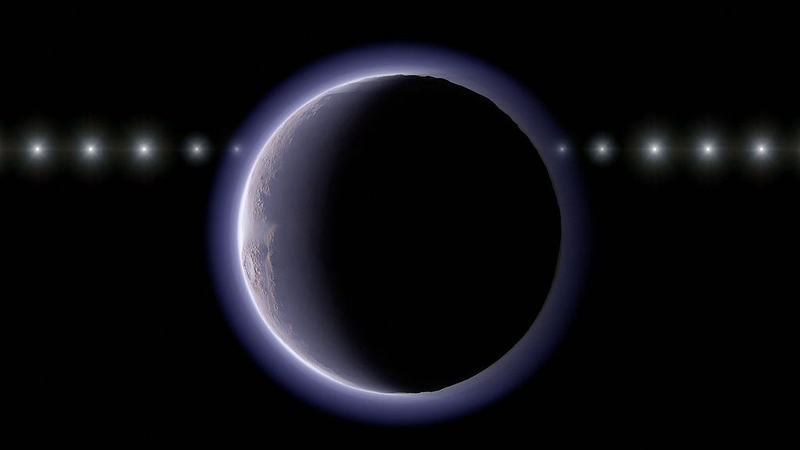
🚀 Hold onto your telescopes, space fans! A tiny world far beyond Pluto might be sporting its own thin atmosphere, and astronomers are buzzing with excitement.
In a study published in Nature Astronomy, a team from the National Astronomical Observatory of Japan announced that the distant icy object (612533) 2002 XV93 could be the second trans-Neptunian world—after Pluto—to host a detectable atmosphere. The rock is about 500 km wide and sits roughly 6 billion km from the Sun, about 40 times farther out than Earth.
How did they spot it? The researchers used a stellar occultation—when the object passes in front of a distant star. In January 2024, they watched the star’s light dim gradually instead of instantly snapping back, suggesting a thin veil of gas was filtering the light.
Lead author Ko Arimatsu explained, "This is important because, until now, Pluto was the only trans-Neptunian object with a confirmed atmosphere." The finding flips the old idea that small, icy bodies in the outer solar system are mostly inactive and unchanging.
What could be puffing up the atmosphere? The team proposes a couple of plausible culprits: explosive cryovolcanoes that shoot gas from the interior, or a recent comet impact that kicked up debris. Both scenarios would produce an extremely thin shroud—five to ten million times lighter than Earth’s atmosphere.
Not everyone is convinced. Spanish astronomer José‑Luis Ortiz, who wasn’t involved in the study, says more data is needed. He suggests the dimming could be caused by a ring hugging the object, not a true atmosphere. Arimatsu acknowledges that exotic alternatives can't be ruled out, but notes that a nearly edge‑on ring doesn’t match the observed pattern.
The discovery also ripples into the debate over Pluto’s planetary status. NASA under US President Donald Trump has floated reinstating Pluto as a full planet, but finding another atmosphere‑bearing world in the Kuiper Belt could muddle that argument. Planetary scientist Adeene Denton quipped, "It’s wild to 'make Pluto a planet again' while decimating the careers of those of us that study it!"
Scientists are now calling for follow‑up observations, especially with the James Webb Space Telescope, to pin down whether 2002 XV93 truly has an atmosphere or something even stranger. For now, the outer solar system just got a little more intriguing. 🪐✨
Reference(s):
Mysterious world beyond Pluto may have an atmosphere, astronomers say
cgtn.com